Pet apparel · GUIDE
Dog Jacket Closures: How to Compare Zippers, Snaps and Hook-and-Loop
The best dog jacket closure is the one that works with the garment's opening, the dog's coat and the person's ability to fasten it calmly. A zipper, snaps or hook-and-loop tabs can each serve a different design. Ask to inspect the actual sample before choosing a fastening for a collection; a closure name alone does not explain how the jacket goes on.
For buyers planning custom pet apparel, this guide turns that choice into questions about opening direction, fit, sample inspection and the information to agree with a supplier.

In this guide
Begin with the whole dressing sequence
Ask for photographs or a demonstration of the jacket fully open and fully fastened. Identify where the dog's head and legs enter, which panels open, and where the caregiver must reach. A jacket may have adjustable tabs but still need to go over the head. Likewise, a zipper shown from one angle may not reveal the full opening.
Sketch the sequence: position the garment, guide each body part through any opening, close each fastener, then check fit. If the design has a harness opening, check that the chosen harness and lead can be used as intended; do not assume that a garment closure is a load-bearing walking attachment.
Compare the closure choices
Zippers
A zipper joins two edges along a track. Ask where the slider starts and ends, whether the track is accessible, and whether a fabric guard separates the moving parts from hair and skin. Check that the edges can be aligned without pulling the garment across the dog's body. A zipper guard is a design detail to request or inspect, not a feature to assume on every jacket.
Snaps
Snaps connect at individual points. Check whether each one can be reached and aligned, whether surrounding fabric stays flat, and whether there are gaps between fasteners when the garment is worn. Ask the supplier to identify the snap construction and placement on the sample. A row of snaps does not automatically make a garment adjustable.
Hook-and-loop tabs
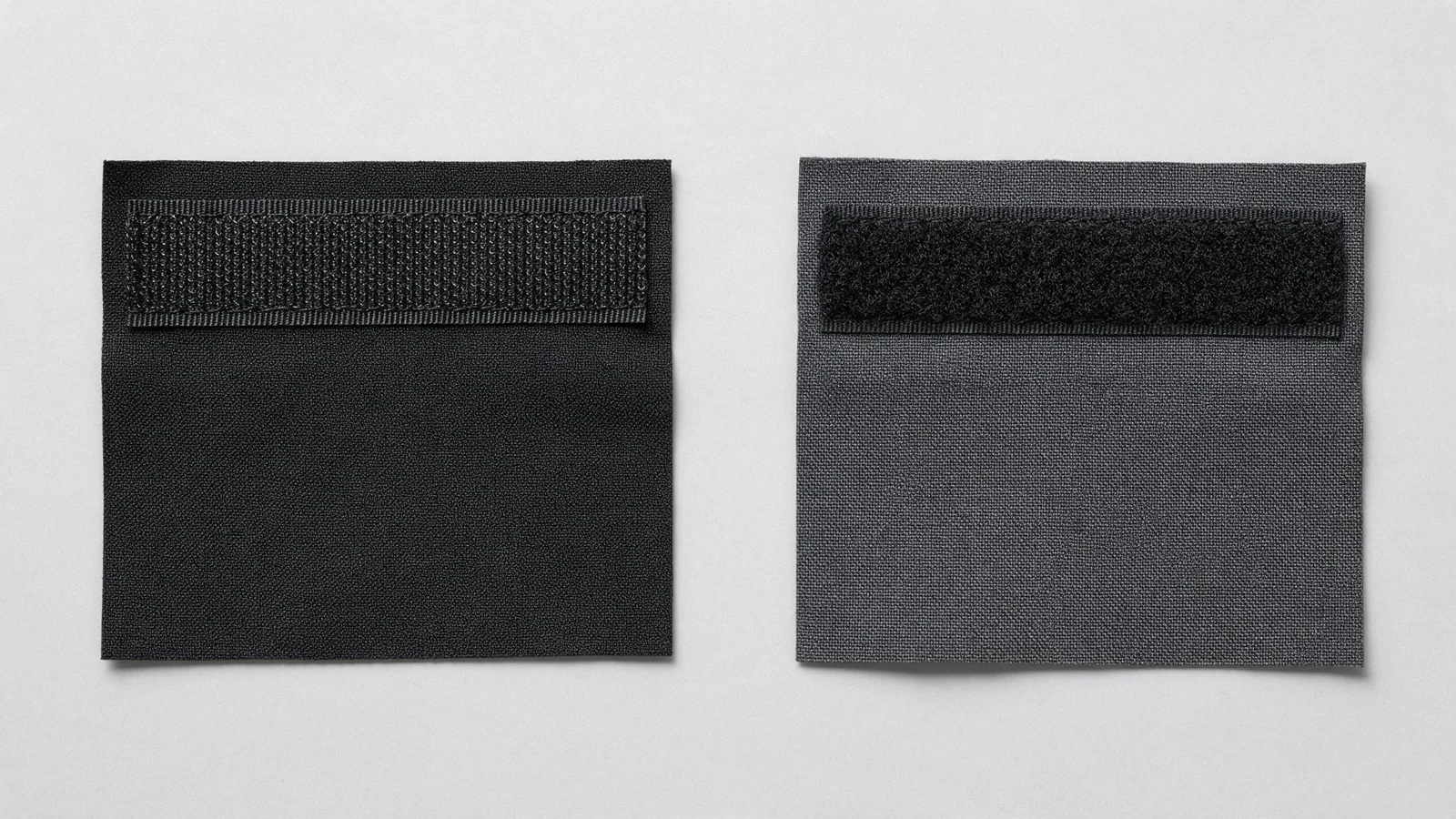
Overlapping hook-and-loop tabs can provide an adjustment range when designed for it. Check how much of each tab actually overlaps at the intended fit and whether exposed hook material contacts fur or other fabric. Ask what the acceptable overlap range is for the specific sample; do not infer it from the tab's appearance.
There is no universal durability ranking among these closures. Compare complete garments under the same agreed evaluation conditions, and ask for any documented test method and results that apply to the proposed construction.
Check fit and movement as well as fastening
A closed fastener does not prove a jacket fits. Compare the actual dog's measurements with the style-specific size chart, then look for excess bunching, restrictive openings and shifted panels during normal, supervised movement. Our dog measurement guide explains the core chest, neck and back measurements.
The American Kennel Club's clothing guide recommends proper fit, gradual introduction and supervision. It also advises removing clothing if a dog becomes stressed and avoiding clothing on a dog left unattended or in a crate. This guidance addresses the whole garment and the individual dog; it does not certify a particular closure.
If the garment catches hair or skin, stop and release it gently. Do not force a closure or continue a fitting when the dog is distressed. For repeated discomfort or an existing health concern, ask a veterinarian for advice.
What should a buyer specify before sampling?
Give the supplier a clear description and ask them to confirm what is available for your project:
- The fastening type, location and direction of opening.
- Whether the jacket opens flat or must pass over the head or legs.
- The number and positions of snaps, or the intended adjustment and overlap of tabs.
- Any requested guard, covering flap or placement away from fur.
- The intended size range and how closure placement changes across sizes.
- The position of any separate harness opening and intended use.
- Care instructions for the complete garment and fastener.
- The sample review criteria, any requested tests, the method and how results will be documented.
Availability, materials and final construction should be confirmed for the order. Share the brief through the custom apparel page, and use our sample review checklist to organize feedback.
Review the sample before approving a collection
Compare the delivered sample with the agreed brief. Open and close each fastener, inspect the attachment and seams, and check that the closure is accessible at the intended size. Note any misalignment, sharp or loose components, exposed hook material and changes needed for the next sample. Record observations on the actual sample rather than treating a drawing as proof of performance.
For an owner-facing fit check, introduce the garment gradually and observe normal movement under supervision. A sample that fastens easily on a table still needs an appropriate fit on the intended dog. Discuss the outcome and any remaining questions with the supplier before approval. See the dog coat style guide for coverage choices that affect the whole design.
Frequently asked questions
Are zippers safer than snaps?
No general ranking can be assumed. Location, construction, fit, the dog's coat and how the garment is used all matter. Review the actual design and ask for relevant evidence.
Do hook-and-loop tabs mean a jacket opens completely?
Not necessarily. Tabs may adjust one part of a pullover. Ask to see the full opening and dressing sequence before ordering.
Can a jacket fastener replace a harness?
Do not assume it can. Confirm the function and instructions for the specific garment and walking equipment; a closure that holds clothing shut is not automatically a leash attachment.
Should every size use identical fastener placement?
Not automatically. Review the design and fit across the intended size range, and agree any placement changes with the supplier.
Preparing specifications? Read our dog clothing tech pack guide.
See our dog clothes rubbing fit check for practical steps when clothing appears to cause discomfort.