Pet portrait rugs · GUIDE
How to Choose a Custom Pet Portrait Rug Size
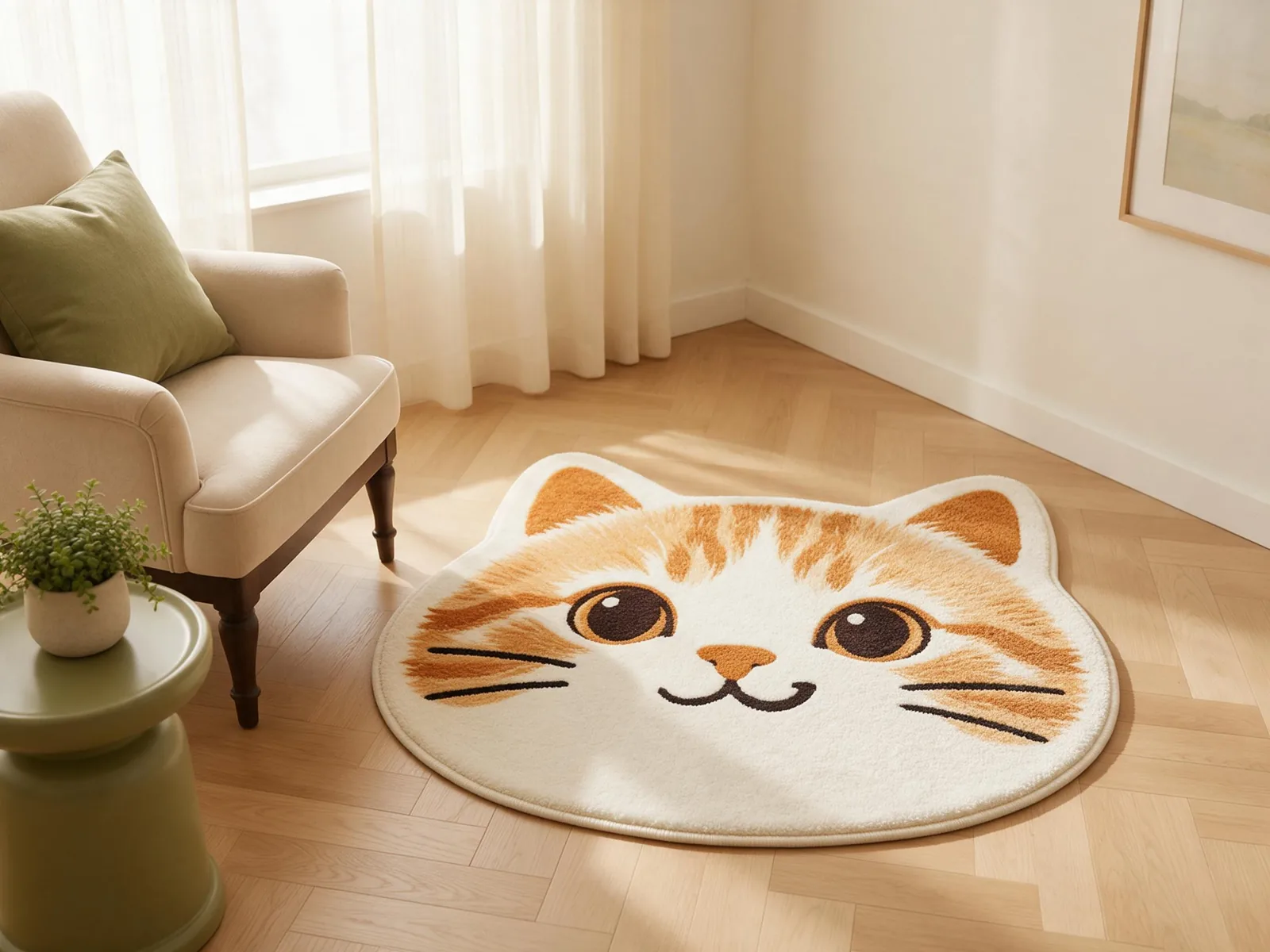
Measure the space where the rug will go, choose a starting longest edge, and ask for the proposed final width and height before you order. A pet-shaped outline can be tall, wide or irregular, so the longest edge alone cannot tell you exactly how the finished rug will fit.
For Mew & Paw portrait rugs, the reference longest-edge options are 60, 80, 100 and 120 cm; 100 cm is a suggested starting point. You can also discuss a custom size. The artwork and final dimensions are confirmed for your project. Start with the custom pet rug options, then use the steps below to make a clearer choice.
In this guide
Understand what “longest edge” means
The longest edge is the larger overall dimension of the proposed outline; it is not automatically the rug’s width, height or diameter. Imagine drawing the smallest horizontal rectangle around the whole design. The rectangle has an overall width and height, including any ears, paws or tail that form part of the outline. The larger of those two measurements is the longest edge.
The shape will not necessarily fill the rectangle. A face with pointed ears and a curled full-body pose can share the same longest edge yet have different widths and different amounts of fabric inside their bounding rectangles. A Print Nest’s shaped rug guide also explains why the outside rectangle and the usable surface of an irregular outline differ; its dimensions and recommendations are for its own products.
A longest edge of 100 cm does not establish a 100 × 100 cm rug. Ask for both proposed overall dimensions, the orientation and the outline. If a wide or tall shape is important, include that in your brief rather than assuming the second dimension.
Compare the reference sizes in centimeters and inches
Use the listed longest edge as a starting point, not a promise of a particular width. Mew & Paw’s current reference choices are shown below; custom dimensions can be discussed.
| Longest-edge reference | Approximate inches | How to use the reference |
|---|---|---|
| 60 cm | 23.6 in | Compare with the maximum space and the intended outline. |
| 80 cm | 31.5 in | Check both final width and height before deciding. |
| 100 cm | 39.4 in | Mew & Paw’s suggested starting point, subject to your space and artwork. |
| 120 cm | 47.2 in | Check clearance around nearby furniture and doors. |
| Custom | Confirm for your project | Share the width and height limits you need to stay within. |
The inch figures are rounded to one decimal place. The U.S. National Institute of Standards and Technology lists 1 inch as exactly 2.54 centimeters. Divide centimeters by 2.54 to convert; retain the original measurement in your inquiry.
A reference size does not guarantee that every composition can be made within every outline. Confirm the design, exact finished dimensions and any tolerance for your order.
Measure the space before choosing
Write down the maximum available width and height of the floor area, not just the length of one side. Measure the area where the rug will actually sit and note fixed limits such as a wall, a bed frame or a doorway.
- Decide how the portrait should face when you enter the room.
- Measure the open area in both directions and record the units.
- Check door swings, drawers, chair movement and the paths people use.
- Note anything that must remain clear, such as a floor vent or furniture leg.
- Photograph or sketch the area for your own reference and mark the limits you measured.
A nearby piece of furniture can help you imagine scale, but it is not a substitute for measuring. If you intend to place the rug where an animal will rest, discuss the intended use and care requirements with the supplier; a portrait outline does not establish a suitable resting surface for every pet.
Match the outline to the portrait
Choose the parts of your pet you want to keep before you settle on a size. A close crop emphasizes the face. A full-body pose may introduce a tail, paws or empty space between limbs that changes the overall outline. Multiple pets introduce another layout decision: their order and relative positions.
Send one main photo for the pose and additional genuine photos only when they clarify a marking or feature. State whether the design should include the whole body, just the head, or another crop. Our guide to choosing a pet photo covers lighting, visible markings and how to label supporting images.
A larger reference edge gives a design more physical room, but it cannot restore a blurred eye or a cropped ear. The final appearance depends on the source image and the proposed artwork; review a proof and ask about the details that matter to you.
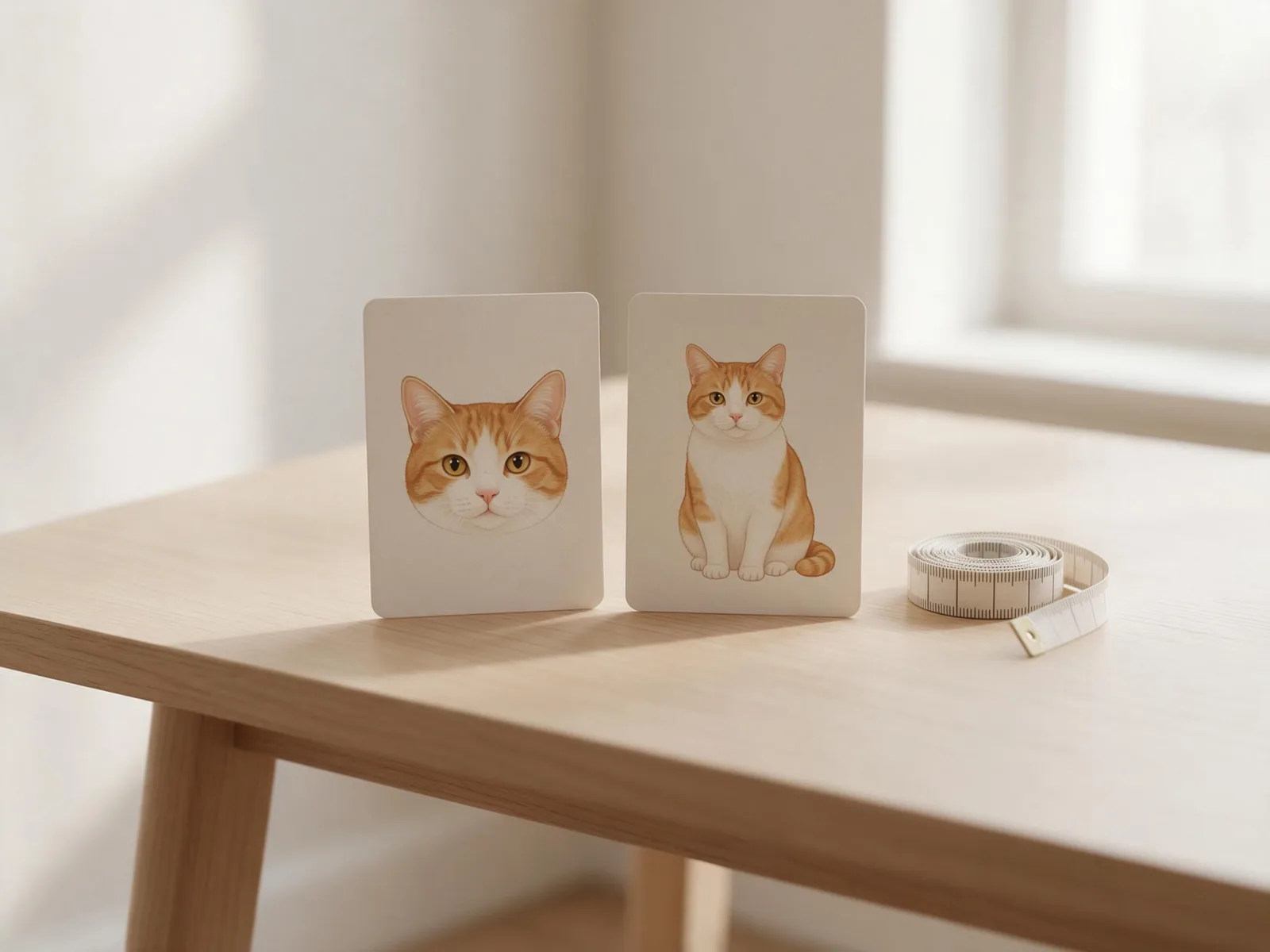
The crop and pose affect the outline you plan.
Preview the footprint at home
Make a temporary paper outline or mark the proposed maximum rectangle, then check it in the intended position. This is a planning aid, not a pattern or a measurement of the finished rug.
If you have only a longest-edge reference, start by marking that length in the likely orientation and note that the other dimension is still unknown. Once the proposed width and height are available, mark those two dimensions. If the shape is irregular, use a paper mock-up of the proposed outline or ask for an outline with measurements. Painter’s tape can help mark a space; check that it is appropriate for your floor and remove it according to its instructions.
Open the door, move the chair and look at the layout from the room’s usual viewing point. If the outline crosses a walkway or furniture boundary, adjust the size or placement and ask for a revised proposal. A Print Nest’s room-measuring checklist similarly suggests checking doors and walkways before ordering.
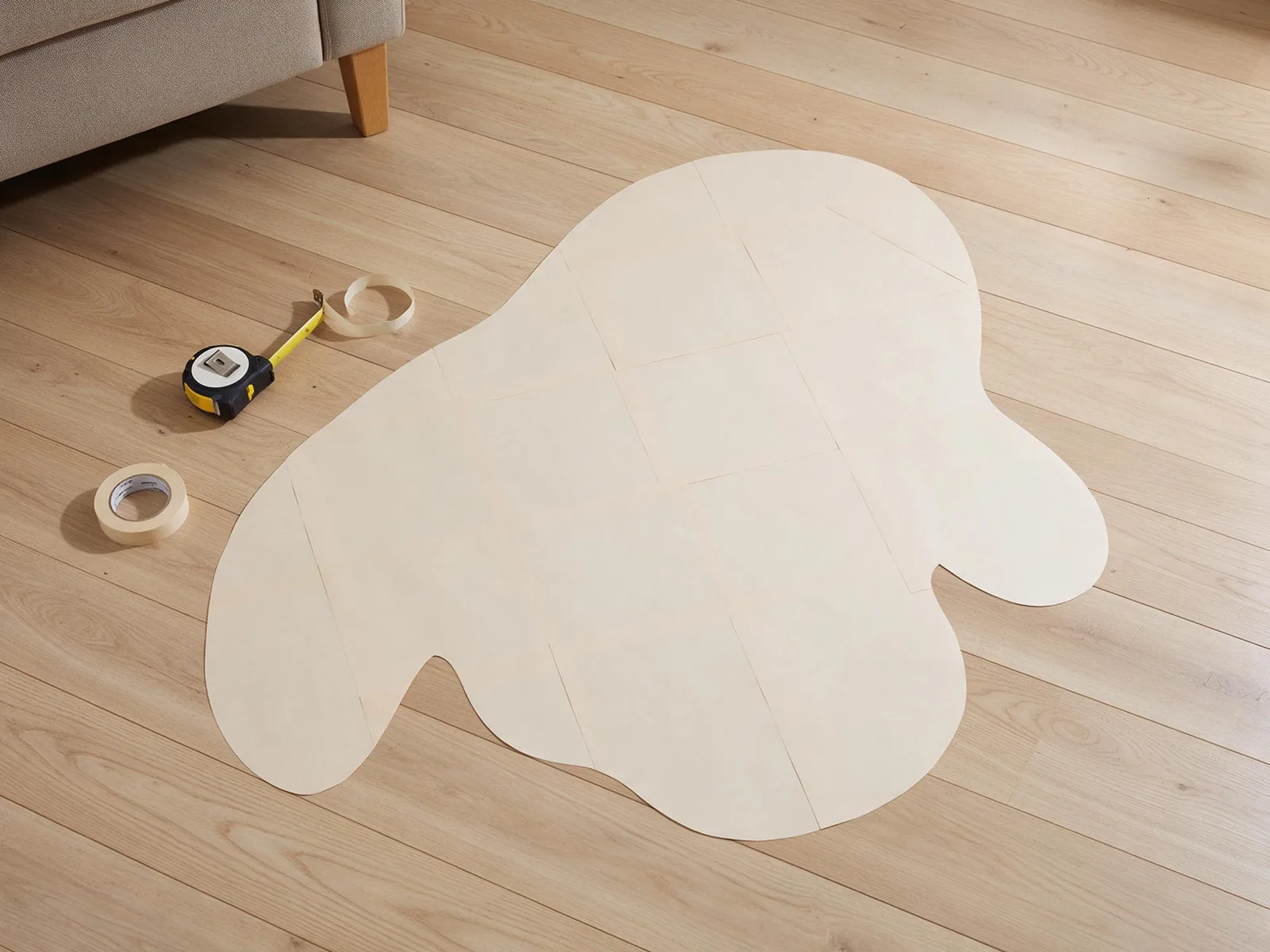
A temporary outline can help you check the space.
A sizing brief you can copy
Send the space limits and artwork choices together so the proposed size can be checked against both.
Main reference photo: The pose and expression to use.
Supporting photos: Which markings or details each photo clarifies.
Portrait outline: Head, chest-up, full body or another shape to discuss.
Preferred longest edge: 60, 80, 100 or 120 cm, or a custom size.
Maximum width and height: The available dimensions, with units and orientation.
Placement: The room and any door, furniture or walkway constraints.
Quantity and destination: The number of rugs and where they are needed.
Questions: Proposed outline, final overall dimensions and tolerance; material, backing, care, samples and timing for this project.
Before approving the proposed artwork, check the width and height against your notes and ask whether the listed measurement includes all parts of the outline. Confirm the final specification with the supplier; the reference list by itself is not a completed production drawing.
Frequently asked questions
Is the 100 cm option always the right choice?
No. It is Mew & Paw’s suggested starting point, not a universal fit. A narrow space, an extended tail or a wider multi-pet layout can change the decision. Ask for both overall dimensions for your proposed artwork.
Is the longest edge the same as the width?
Only when the width happens to be the larger overall dimension. A tall outline may instead have its height as the longest edge. Check the orientation and both measurements in the proposed design.
Can I request a size between the listed options?
You can ask about custom dimensions. Share your preferred longest edge and maximum width and height; availability and final specifications need confirmation for the project.
Will a larger rug make a poor photo clear?
Not necessarily. More physical space cannot reliably recover missing or blurred features in a reference image. Choose the clearest genuine photo available and discuss any uncertain detail before the artwork is finalized.
Discuss your pet rug
Explore custom pet portrait rugs and send your photo, preferred longest edge and floor-space limits through the inquiry form. The proposed shape, overall dimensions and order details can then be confirmed for your project.
Continue planning: review your pet rug design.
Next, read how to care for a custom pet portrait rug and which instructions to request.
For placement and pad questions, read how to keep a pet portrait rug from slipping.